

A Winding Journey to the Center: Walking Labyrinths (Part 1)

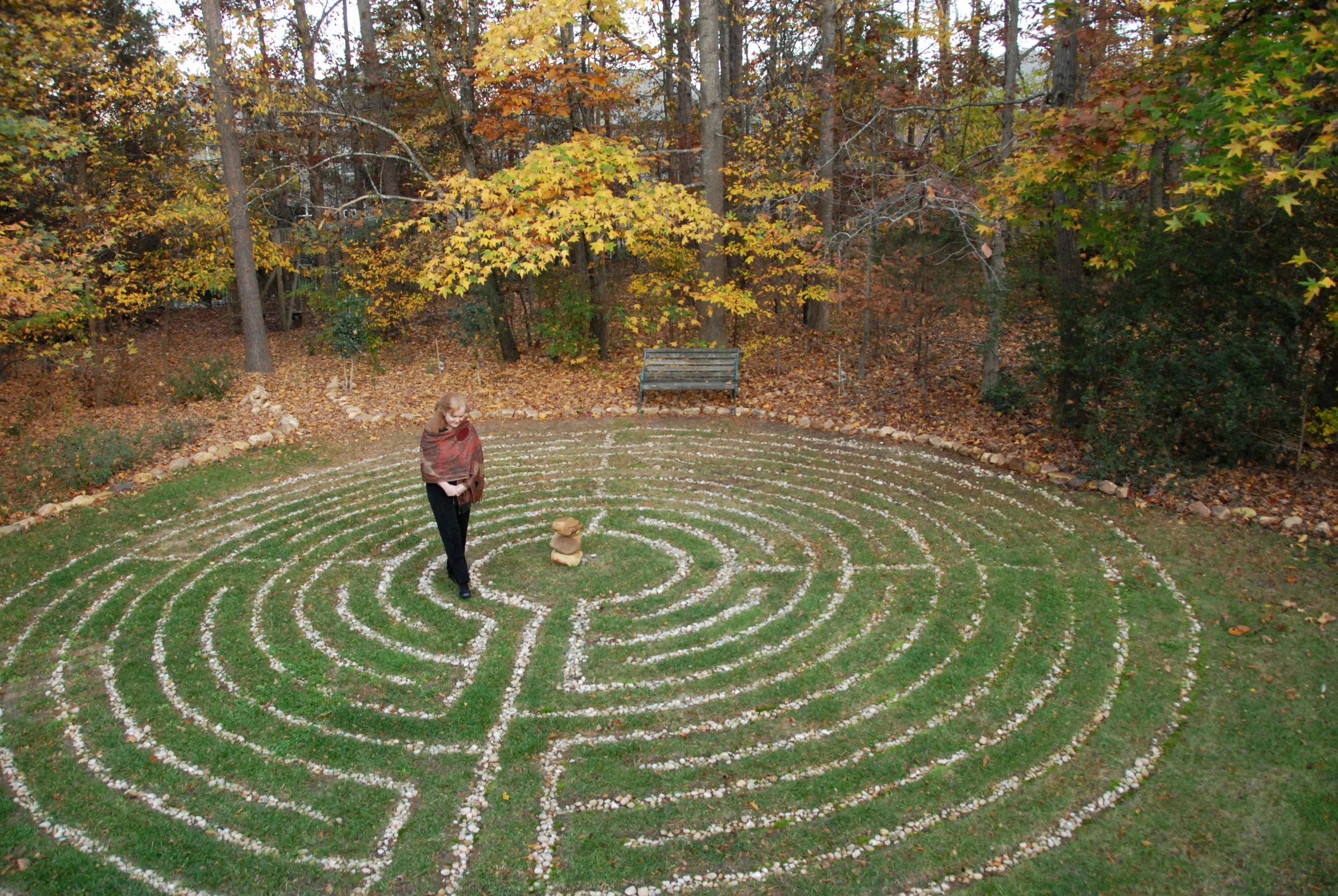
It is a cold, moody day in February as the afternoon is burning down. I park in the Abbey lot, get out, and take a look around. For a Benedictine monastery, it’s less assuming than I expected, just casually sitting by the road in small-town southeastern Massachusetts. It is a monastery though, so I guess it shouldn’t be too assuming.
Glancing casually over what appears to be a chapel and some dormitories, I make my way along a path that leads up a small incline to the edge of a treeline, and there I see small, unobtrusive wooden, handwritten sign that says “Labyrinth” and points inward. A few steps into the trees and I am there: a clearing, and an array of arranged stones half covered by last autumn’s dead leaves.
Again, I’m not sure what I expected. Something more…prominent? This just looks like ancient ruins. But I’ve come all this way, so I might as well do it.
****
In my Introduction to Spirituality course at Merrimack College the previous fall, my classmate Ron presented on labyrinth walking. Thinking back now, I can’t recall many specific details of the presentation, but I remember being tremendously intrigued. Growing up in my corner of the Christian tradition, labyrinths weren’t even a thing. As I got older, I heard about them here and there, but they sounded more like pieces of art, fun floor mazes for kids and maybe childlike adults. Ron’s presentation opened up my eyes to the fact that labyrinth walking had been a deeply meaningful Christian spiritual practice for hundreds of years, at least since the Middle Ages, if not earlier.
Thankfully, Ron mentioned several Massachusetts-area labyrinths in his presentation, including the one at Glastonbury Abbey in Hingham, about an hour away from me.
****
So here I am, several months after that class, on a late Friday afternoon at the end of winter, standing in a leaf strewn clearing at Glastonbury, a bit unsure if I’ve wasted my time driving all this way for a pile of stupid rocks.
I’ve never done this before, so I’m not sure how to begin. Should I cross myself? Should I kneel and pray? I’ve heard that people sometimes bring a small object with them through the labyrinth and leave it at the center. I look around me and spot a pine cone near my feet, so I grab it. And I begin.
****
Before I continue, perhaps it’s helpful to stop for an explanation. “What even is a labyrinth?” you may ask. As Dr. Lauren Atress explains in her book Walking a Sacred Path: “Labyrinths are usually in the form of a circle with a meandering but purposeful path, from the edge to the center and back out again, large enough to be walked into. Each has only one path, and once we make the choice to enter it, the path becomes a metaphor for our journey through life, sending us to the center of the labyrinth and then back out to the edge on the same path.”
The most famous labyrinth in Christian tradition is laid into the floor of Chartres Cathedral in France. Built in the 13th century, its four quadrant, winding structure to a central rosette has set the pattern for many labyrinths that have come after.
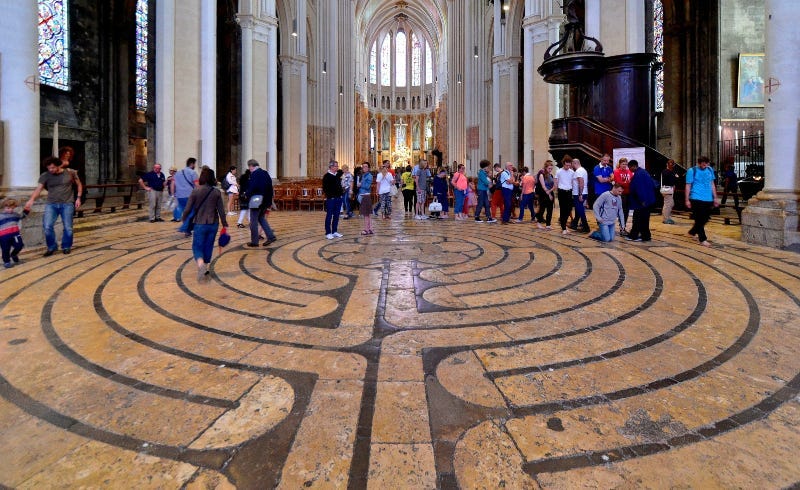
Labyrinths rose to prominence in the Middle Ages when, due to the Crusades, it was no longer safe for most Christians to make pilgrimage to Jerusalem. “In response to the situation, the Roman church appointed seven pilgrimage cathedrals to become the ‘Jerusalem’ for pilgrims. The walk into the labyrinth in many of these cathedrals marked the ritual ending of the physical journey across the countryside. It served as a symbolic entry into the spiritual realms of the Celestial City.”
As Dr. Artress also points out, a labyrinth is not a maze, although they may appear similar at first glance. Whereas a maze has many false paths and dead ends, a labyrinth, though winding, always has one single path leading to the center and back out again. It can be trusted to lead you, albeit circuitously.
While there can be many ways to walk a labyrinth, much labyrinth walking seems to follow a typical pattern of Releasing, Receiving, and Returning, or Purgation, Illumination, and Union. As we take the path inward, the twists and turns quiet our inner turmoil, help us release our struggles, and submit to the journey. As we arrive at the center, we pause to receive whatever it is God might have for us. We might put down any small object we have carried with us into the labyrinth as a symbol of laying down our burden. Perhaps we might receive an insight into our circumstances. We then return on the path back out, hopefully feeling more quieted and connected to God, ready to confront the world again.
****
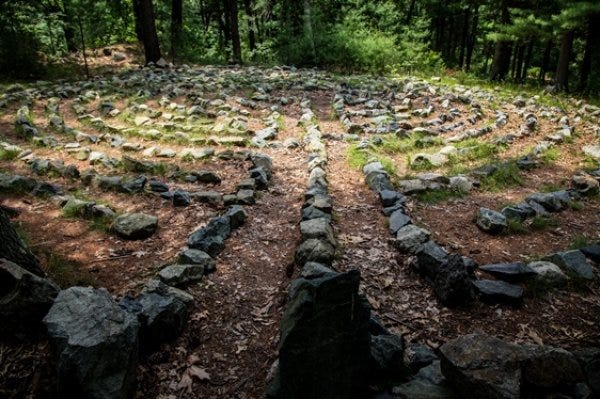
I walk amid the narrow set of stones, my feet rustling the dry, brown leaves. I admit, there is something comforting about just surrendering to the path. There is no guessing or decision making, just taking one step after another, one turn after another.
At some point probably about halfway to the center though, doubt begins to creep in. “This is so stupid”, I think. “I must look like an idiot. I’m in a clearing in the woods taking these twists and turns because these 3-inch-high borders of rocks are telling me I should? Screw this. I should just skip on over these stones and back to my car and home.”
But I don’t. There is nobody around but me and the dead winter trees. As I continue walking, something begins to happen. A settling. I hadn’t gone into the labyrinth with any particular dilemma or problem on my mind. But I do feel everything inside me start to still.
At some point, I arrive at the center of the labyrinth, a circle within the larger circle. I place my pinecone down. No mystical vision happens, no lighting strike, no moment of illumination, just quiet spaciousness. I just stand there for a few minutes, enjoying the silence, and then I start heading back.
The return is different. There is no internal quarrel, no fighting, just a sense of peace. I let the return journey be what it is, one step at a time. And soon, I am back at the beginning where I started maybe twenty minutes ago. But something has shifted. I feel a sense of integration, reorientation, and calmness that I hadn’t before.
****
I would later write a poem about my experience walking the Glastonbury labyrinth. I present it for you here:
Walking the labyrinth
at Glastonbury Abbey,
my shoes rustling the dead leaves
as I pass through lines
of rough stones,
I realize
this is the path of faith,
and not,
a straight and narrow way
but rather
a winding, doubling-back
“where is this taking me”
journey to the Center.
You will want to give up.
You will want to say “hell with it”
and skip right on over those stones
and out.
But if you commit,
if you surrender to the path
and let it lead you,
one mundane step after another
you just might find yourself,
yes, the self you lost
in the hustle and the noise.
You just might find yourself
accompanied by a Presence
you had long missed.
You just might find yourself
rediscovering Everything
if only for a moment.
****
As you’ll observe in the poem, my major takeaway from my labyrinth experience was how it confronted the dominant visual metaphor of the faith journey that I’d grown up with. I can’t tell you how many times I heard the “straight and narrow” referenced in my Christian tradition. For me, it always conjured up the image of some highway out in middle America, undeviating like an arrow to the horizon.
Of course, I don’t think that’s how any authentic faith journey works at all. At least for me, it has indeed been:
a winding, doubling-back
“where is this taking me”
journey to the Center.
As with the spiritual journey, there are times in labyrinth walks where one appears to be very close to the center, only to move away to the very edge of the circle a few steps or turns later. Trying to predict where the path is going is difficult and often counter-productive. Usually there is only the surrendering, the one-step-at-a-time, the trusting that this is all going Somewhere.
To be continued…