

Resisting Like Hobbits
How Tolkien teaches us normies to counter evil

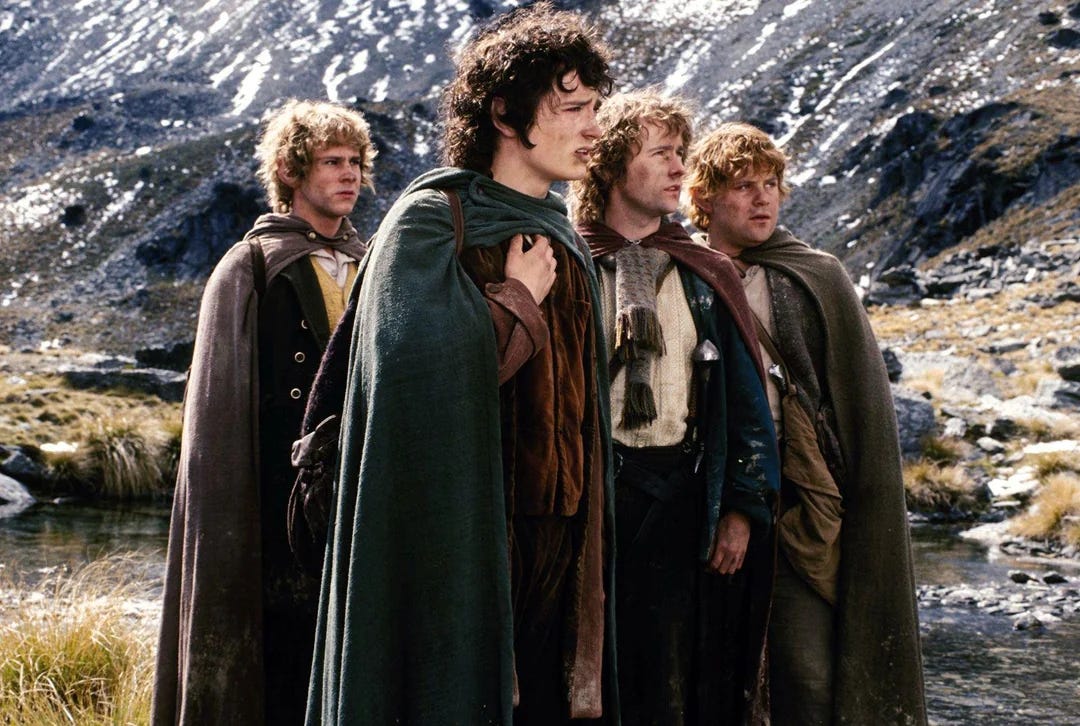
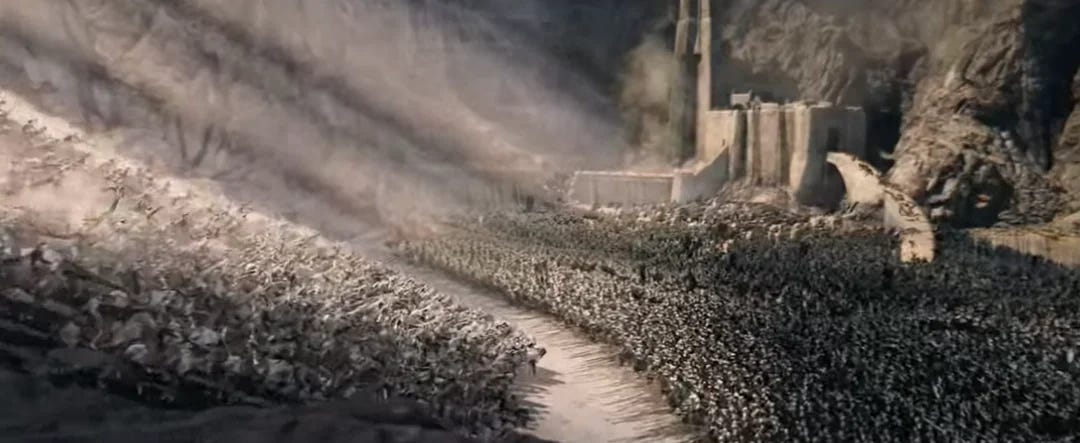
There’s a scene from The Two Towers film that I’ve thought about a lot this past year. It’s the Battle of Helm’s Deep, and things are not going well. Our heroes are preparing one final stand in the keep as the Uruk-Hai attempt to batter down the doors of the Hornburg. Aragorn is attempting to rally the survivors while King Théoden contemplates the end:
“So much death,” he says. “What can men do against such reckless hate?”
“Ride out with me,” Aragorn responds. “Ride out and meet them.”
“For death and glory,” Théoden replies.
“For Rohan,” Aragorn says. “For your people.”
“Yes…yes,” Théoden replies. “The horn of Helm Hammerhand shall sound in the Deep one last time. Let this be the hour when we draw swords together. Fell deeds awake. Now for wrath, now for ruin, and the red dawn! Forth Eorlingas!”
You probably know the rest. They charge, slaying the Uruk-Hai as they ride, then Gandalf shows up with the dawn, riding down the hill with a wave of Rohirrim warriors. It still gives me chills every time I watch it.
Sometimes I wish life was that easy.
We live in times where darkness is spreading across the land. Our country is being led by an unprincipled demagogue who has apparently taken up the casual sport of invading or contemplating the takeover of other countries, and who thinks the only limit on his power is his own “morality”. Meanwhile, masked government thugs terrorize the streets. A U.S. citizen was just m*rdered last week in broad daylight by an ICE agent.
Racism and xenophobia are just everyday parlance from the highest halls of power in our nation.
What can men do against such reckless hate?
The irony of where I’m going with this whole thing, is that the Republicans and tech-bros currently ruling our society would claim that they are inspired by The Lord of the Rings as well. Our Vice President J.D. Vance has proclaimed himself a huge Lord of the Rings fan, and has said that the mythology has influenced both his conservatism and his conversion to Catholicism. He even named his venture capitalist firm Narya, after one of the elven rings of power. I guess it’s no surprise, since Vance’s mentor, tech-bro Peter Thiel is also a self-proclaimed Tolkien nerd who has named numerous companies with Tolkien references: Anduril (AI powered warfare technology), Palantir (AI powered government surveillance), Mithril Capital, Rivendell One LLC, and Valar Ventures (all venture capital investment companies)1
But more seriously, many of these men currently wielding power envision themselves as Tolkien’s human heroes, the “Men of the West”2 standing against the forces of evil, in their case the forces of “evil” being liberalism, immigrants, Islam, etc.3
Many have pointed out how bad of a misunderstanding of Tolkien’s mythology this is. As someone who has loved and studied Tolkien’s world for decades, let me throw my own opinion into the scrap by arguing that the heart of The Lord of the Rings isn’t about what the “great men” of the story do at all. Among themes like the corrupting influence of power, and the value of community and friendship, the heart of The Lord of the Rings is Tolkien’s small folk—the hobbits. And I believe they are who we should be taking cues from in these dark times.
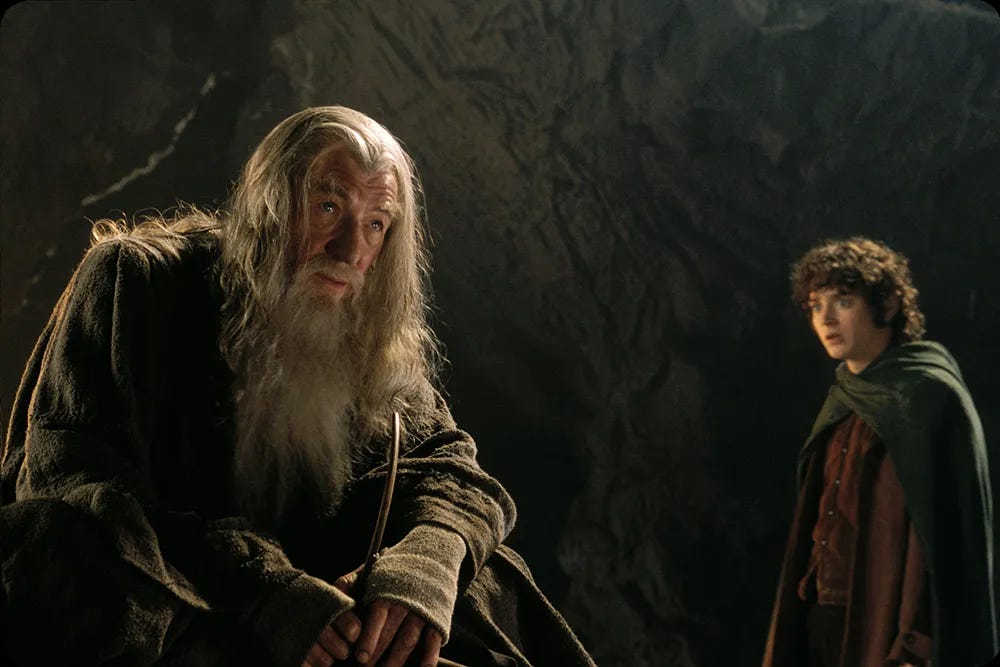
Frodo: “I wish the Ring had never come to me. I wish none of this had happened.”
Gandalf: “So do all who live to see such times. But that is not for them to decide. All we have to decide is what to do with the time that is given to us.”
-The Fellowship of the Ring
The hobbits are an apt example for many of us in so many ways. They’re normies. They like their food and drink, their cozy homes. They want to live lives of simplicity and peace. They can also be (like us) petty, insular, and gossipy. They’re apt to bury their heads in the sand about the doings of the wider world. But, when push comes to shove, they can be surprisingly resilient and brave (even if they complain while doing it). And the courage they show, when brought to it, is not the sword-wielding, “ride out and meet them” type. It is small and steady and often accompanied by a lot of fear and trepidation. It is one step in front of the other.
Take, for example, Bilbo Baggins in The Hobbit, reluctant “burglar” and adventurer. When at last the moment comes for him to face Smaug, Tolkien writes:
“It was at this point that Bilbo stopped. Going on from there was the bravest thing he ever did. The tremendous things that happened afterwards were nothing compared to it. He fought the real battle in the tunnel alone, before he ever saw the vast danger that lay in wait.”
At this point in the story, Bilbo has escaped goblins, fought giant spiders, riddled with Gollum, and rescued his friends from elvish prison. The Battle of the Five Armies awaits. But that moment to keep going down the tunnel to face Smaug is apparently bravest thing he did in the whole story.
Or let’s go back to The Two Towers. While characters like Gandalf, Aragorn, Legolas, Gimli, and Théoden are off doing the sexy stuff like slaying orcs, Frodo and Sam are just…plodding. Wandering the misty crags of Emyn Muil. Trudging through the Dead Marshes. Climbing the endless stairs to Cirith Ungol. It’s not very exciting compared to the other storyline. Frodo and Sam even have a conversation about this:
“Yes, that’s so,” said Sam. “And we shouldn’t be here at all, if we’d known more about it before we started. But I suppose it’s often that way. The brave things in the old tales and songs, Mr. Frodo: adventures, as I used to call them. I used to think that they were things the wonderful folk of the stories went out and looked for, because they wanted them, because they were exciting and life was a bit dull, a kind of a sport, as you might say. But that’s not the way of it with the tales that really mattered, or the ones that stay in the mind. Folk seem to have been just landed in them, usually - their paths were laid that way, as you put it. But I expect they had lots of chances, like us, of turning back, only they didn’t. And if they had, we shouldn’t know, because they’d have been forgotten. We hear about those as just went on - and not all to a good end, mind you; at least not to what folk inside a story and not outside it call a good end. You know, coming home, and finding things all right, though not quite the same - like old Mr. Bilbo. But those aren’t always the best tales to hear, though they may be the best tales to get landed in! I wonder what sort of a tale we’ve fallen into?”
“I wonder,” said Frodo. “But I don’t know. And that’s the way of a real tale. Take any one that you’re fond of. You may know, or guess, what kind of a tale it is, happy-ending or sad-ending, but the people in it don’t know. And you don’t want them to.”
Like Frodo and Sam, we don’t really know exactly what kind of story we’ve been thrust into. We don’t know what the ending of this chapter will look like. We know that the skies look dark, and that forces of hate, racism, and xenophobia are trying to prevail. Most of us are just hobbits, caught out here in our everyday lives, wondering what the hell is going on and what the hell can we do?
In response I’m reminded of a scene from the first Hobbit film:
To me, this captures the heart of Tolkien’s story. It’s not ultimately about wizards and heroes and Dark Lords. It’s about the small acts. It’s the No Kings standout I see driving by a random corner in a little town. It’s the story I heard of an unnamed woman handing out tea to people mourning Renee Nicole Good in Minneapolis. It’s looking out for your neighbors, loving your family, donating to the local food bank, calling your representatives.
Most of us are very small creatures in the wide, wide, world. We’re not warriors or wizards or world leaders. But that doesn’t mean who we are or the simple things we do don’t matter.
Pretty sure Treebeard would describe these jabronies as having, like Saruman, “minds of metal and wheels”.
The irony is that Tolkien portrays the “Men of the West” in his story as easily prone to weakness or corruption. Denethor is deluded into despair by Sauron via a Palantír (take note Peter Thiel), Boromir thinks he can take the Ring and use it for good, Théoden is reduced to impotence by Gríma Wormtongue’s lies until Gandalf comes and frees him.
Basically anything not “white” and “Christian”
So good Chris. This is fantastic.
Chris, this is excellent. I’m always grateful for your voice and writing.