

The Alchemy of Hamnet
How art transforms grief

"Give sorrow words; the grief that does not speak whispers the o'er-fraught heart and bids it break." – William Shakespeare
In a clip that has made the rounds on social media the past few years, acclaimed actor and writer Ethan Hawke talks about the importance of art by saying:
Most people don’t spend a lot of time thinking about poetry, they have a life to live and they’re not really concerned with Allen Ginsberg’s poems or anybody’s poems. Until... their father dies, you go to a funeral, you lose a child, somebody breaks your heart, they don’t love you any more and all of a sudden you’re desperate for making sense out of this life and “has anybody felt this bad before, how did they come out of this cloud?”….that’s when art’s not a luxury, it’s sustenance.
As Hawke points out, there come times in our lives where art becomes the only way to process pain or to feel grief. That’s when the artist’s time to shine comes.
What we don’t always think about in those moments is the fact that when the artist was painting that picture, writing that poem, scripting that play, they were doing so as a way to process the pain of their own loss. Through a kind of alchemy, they were able to wrestle with their own darkness and capture something eternal that would carry on to touch other people down through the ages.
Hamnet, the 2024 film by Chloe Zao, based on the 2021 book of the same name by Maggie O’Farrell, imaginatively explores such a process in the life of William Shakespeare, after the loss of his 11 year old son Hamnet to the plague.
The Marriage of Opposites
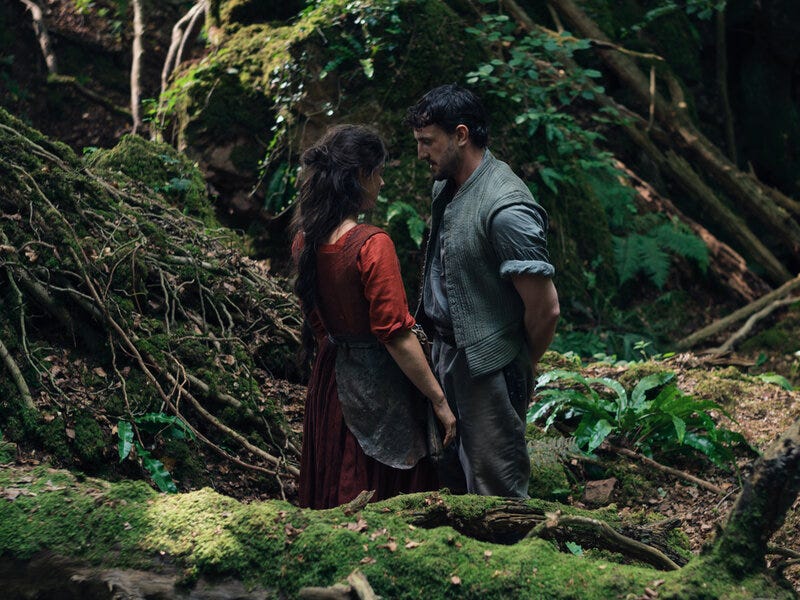
When Will meets Agnes at the beginning of our story, they are opposites in most ways. We encounter Agnes sleeping on the leaf strewn forest floor, under a massive old tree. Agnes is an herbalist and a healer, said to be the daughter of a forest witch. She is embodied, intuitive, rooted in the land an in non-verbal knowledge of plants and weather. Will on the other hand, is a Latin tutor, the educated son of a glove maker. He finds it difficult to engage with people, but his head is bursting with words and ideas. If Agnes is Earth, Will is Air.
It is this oppositeness that creates chemistry between them and draws them together. But it also pulls them apart. After they are married and have a child, Agnes realizes that Will is going mad being stuck in Stratford, and that he is destined for bigger things in London, and so she sends him off. Their marriage is defined by a kind of productive tension. Will goes to London for spells to work on the stage, while Agnes tends the children and home back in Stratford. They seem happy, but they are not quite together, and this tension will form a rift when tragedy strikes.
Twin Flames
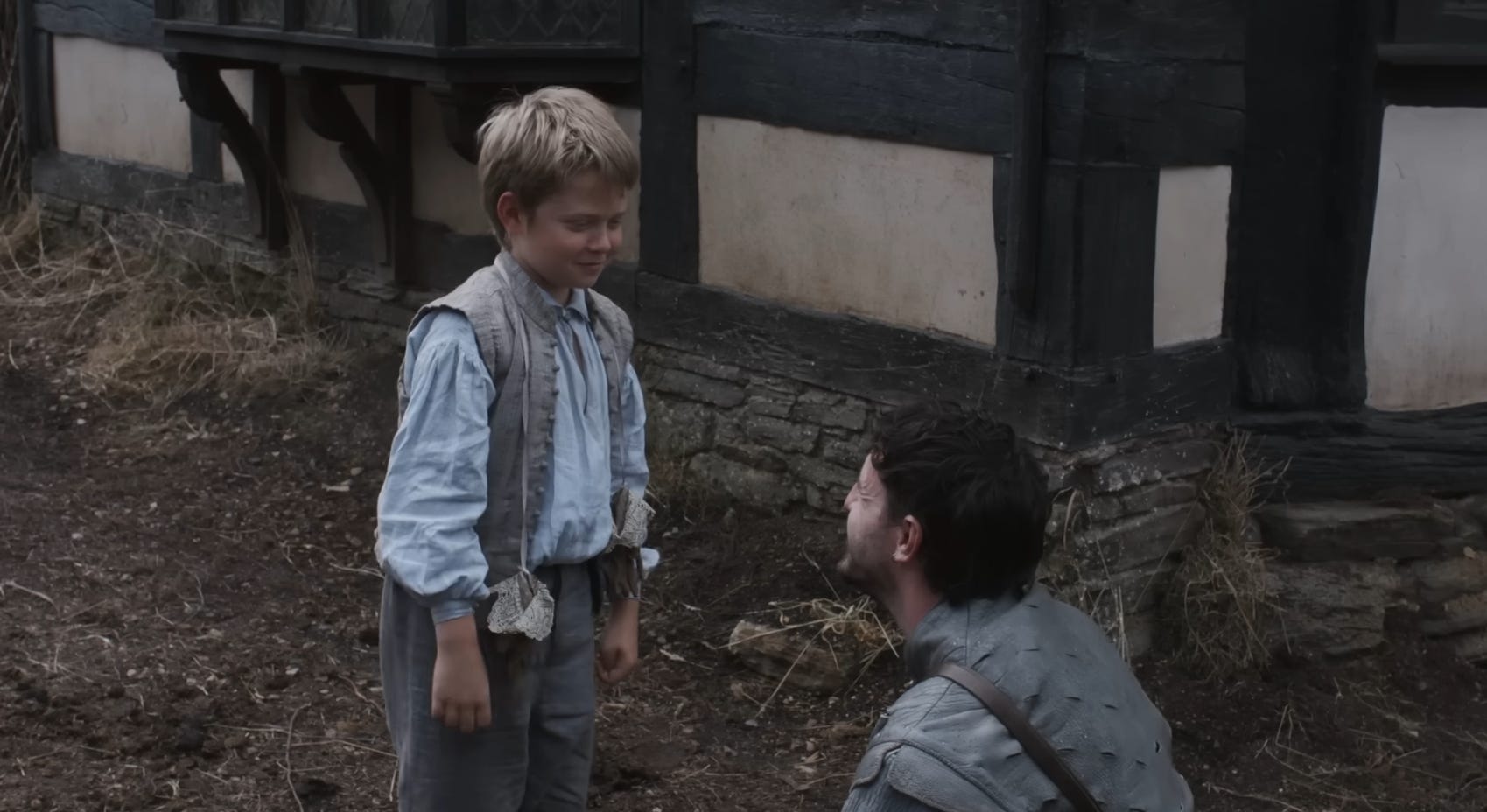
In the novel/film, as in real life, the alchemy of Will and Agnes’ love gives birth to their precious twins, Hamnet and Judith (along with their older daughter Susanna). Agnes, who can sense the future, has had a vision that she will die with two children by her bedside. When the twins are born, Judith appears stillborn, but Agnes revives her. This introduces an ominous foreboding in the rest of the film—if Agnes’ vision proves true, that means one of her children must die.
Hamnet and Judith’s deep bond but also interchangeableness is played with throughout the film. When we meet them some years after they are born, they are dressing up in each others’ clothes to trick their father at the breakfast table. This scene is rendered playfully, but hints at a darker truth that these children really aren’t as interchangeable as they seem. Their closeness makes substitution imaginable—but also unbearable.
When they are 11, death approaches in the form of the plague. Judith falls ill, and Agnes plies all her herb-lore to save her. As Judith lies sick at night, Hamnet comes crawling into bed with her and whispers that he will take her place, that he will trick Death and have it take him instead. Hamnet falls ill and dies, even as Will is racing home from London. In a sort of reverse alchemy, Hamnet’s life is unmade to preserve Judith’s. A life is saved, but there is a loss of symmetry that can never be reversed, like the feeling of a phantom limb after amputation.
Art and Grief
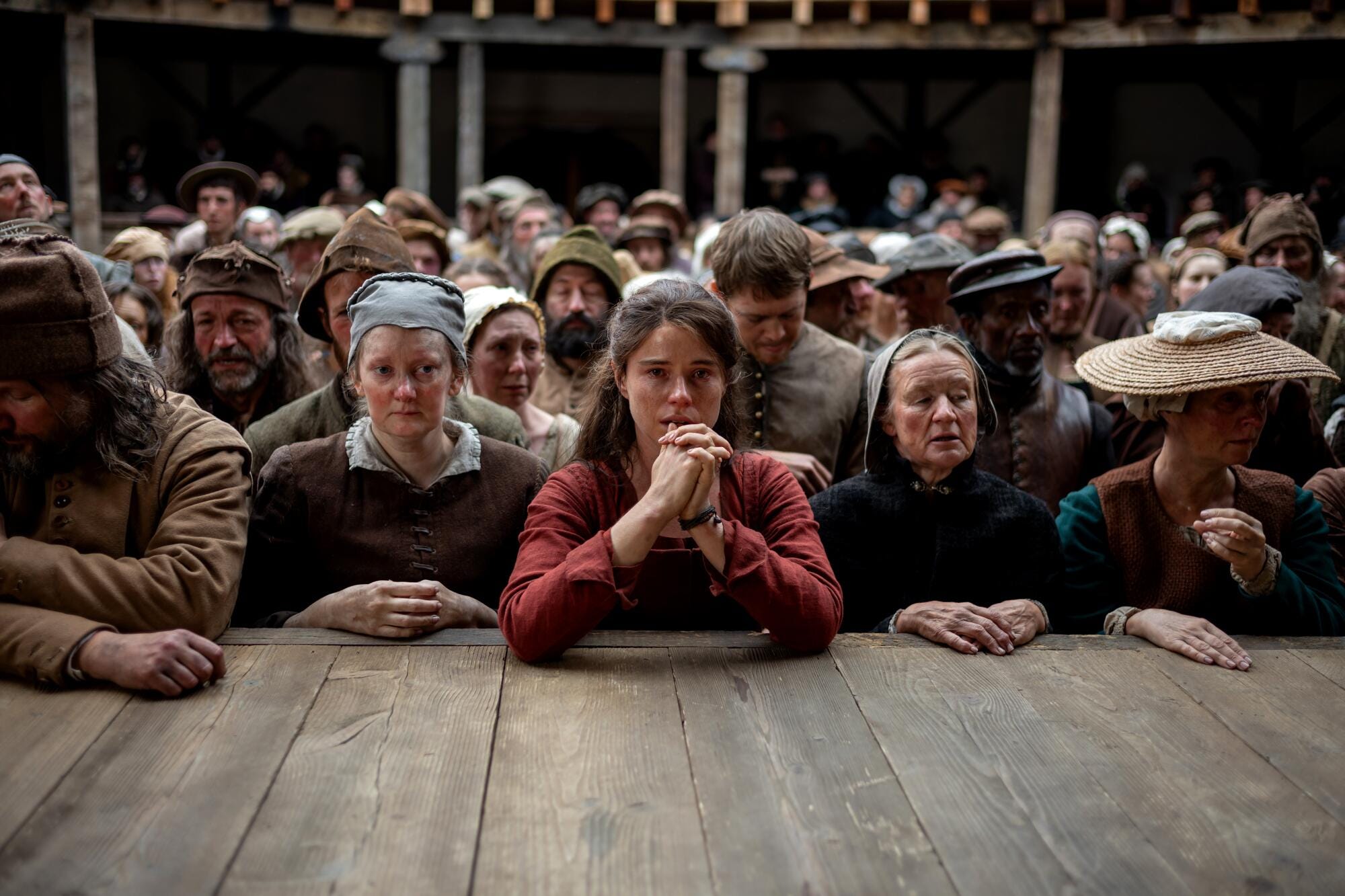
The tension at the heart of Will and Agnes’ marriage explodes into a rift upon Hamnet’s death. Agnes absorbs the loss somatically—she screams and moans like an animal in pain. Will, on the other hand, is struck dumb. Arriving too late, he is overjoyed to find that Judith is well, but is blindsided to discover that Hamnet has died instead. He soon returns to London, much to Agnes’ anger. She cannot understand why he is seemingly not flattened by this tragedy. The reality is that he must process it in another form.
Some time later, Agnes receives word that Will’s latest play is about to go onstage in London. It is called Hamlet1. Confounded, she heads to London to see what this is all about. Is Will exploiting their son’s death?
When the play begins, we sense Agnes’ frustration and anger. Why are these actors casually tossing about her son’s name in their mouths for entertainment?
But then the scene between Hamlet and his father’s ghost arrives, and the spectre is played by none other than Will2. At the end of the scene, an overcome Will utters the lines, “Adieu, adieu! Hamlet, remember me.” Agnes in this moment begins to see the grief her husband has been carrying. We, the audience, see something even more significant—that Will has constructed a play in which he has performed an interchange of his own, where he has died while Hamnet has lived. He has also created a scenario where he gets to bid his “son” goodbye every performance, something he was not able to do in real life.
As any of us good students of Shakespeare know, the play ends with Hamlet being poisoned by the sword point of Laertes. The young actor “dies” in front of Agnes, uttering the lines: “If thou didst ever hold me in thy heart / Absent thee from felicity awhile / And in this harsh world draw thy breath in pain / To tell my story.” Agnes, and then the audience, reach their hands out to the actor, and in that moment she imagines she sees a smiling Hamnet exiting the stage.
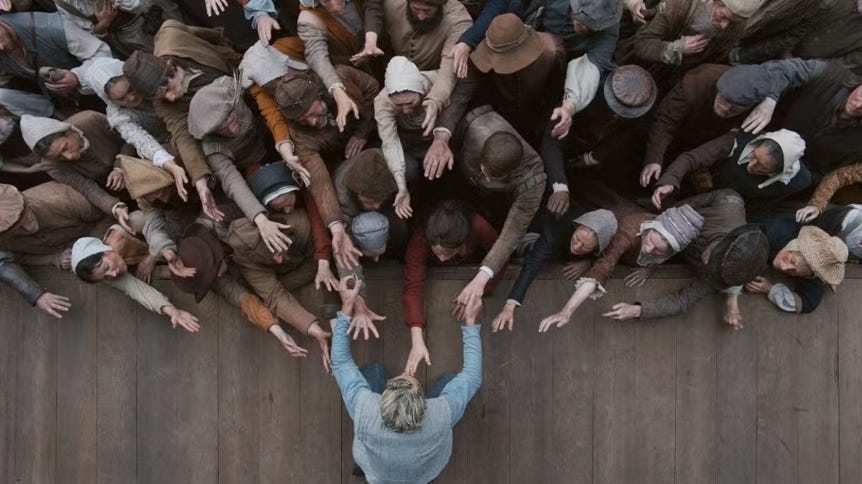
In that moment, Agnes’ own grief is healed a little, and she realizes that Will loved Hamnet just as much as she did, and was grieving him in the only way he knew how.
Art is Sustenance
Whether the narrative of Hamnet hews accurately to the reality or not, the film is a powerful reminder that great art is not made in a vacuum, but often arises out of the deep vicissitudes of the creator’s own life. And by some process that we still don’t quite understand, these artists are able to transmute their own pain into something beautiful that reaches across time to touch others in their moments of pain as well.
According to an epigraph at the beginning of the film, the names Hamnet/Hamlet were essentially interchangeable in Elizabethan England.
According to my knowledge, scholars believe that Shakespeare did indeed play the ghost of Hamlet’s father.
I haven’t watched this move yet, but now I really want to. I do love that idea of art as alchemy.